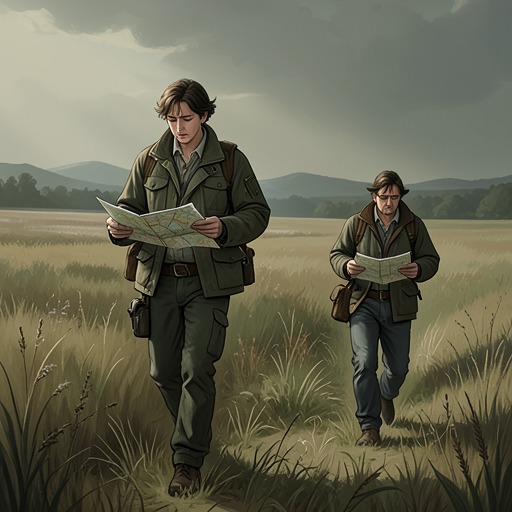
Wandering Notebook
All the Bright PlacesThe Wandering Notebook is the shared record Theodore Finch and Violet Markey make of their travels, but it gradually becomes more than a log of destinations. Violet uses it to preserve moments that do not count as official wanderings, to record what she sees, and to think through questions about her life and future. Its changing uses trace the relationship between the two teenagers: the notebook is at once a record of time spent together and a place where Violet can continue addressing thoughts to Finch when he is absent.
A shared record of the wandering
On a Sunday night in her bedroom, Violet turns through the notebook she identifies as belonging to both her and Theodore Finch. She picks up a pen Finch gave her and opens a blank page. The gesture joins two objects associated with their time together: the notebook that holds their shared experiences and the pen he gave her, now in her hand as she adds to their record. The page is not simply a place to list where they have been. It gives Violet a way to decide which moments deserve to be remembered.
The book already contains experiences beyond the project’s official itinerary. Violet reflects that Bookmarks and Purina Tower do not qualify as official wanderings, but that status does not make them unworthy of inclusion. Her entry places those visits within the couple’s record all the same. The distinction between official and unofficial becomes less important than the notebook’s broader purpose: keeping hold of what the two of them have experienced, including the parts that fall outside the assignment’s rules.
Observations and remembered scenes
The notebook also serves as a surface for close observation. During a winter visit to see a wandering crane, Violet watches Finch swim and then writes about both the crane and the boy in the red cap. She loses track of time while writing, and when she looks up, Finch is floating back toward her. The page thus preserves a scene made up not only of a destination or activity but of its particular companions and circumstances. The notebook lets Violet attend to the moment while it is unfolding, then retain it in words.
That scene also shows how the object belongs to their shared practice without requiring them to write at the same time. Finch invites Violet into the water; she declines, and instead the notebook gives her something to do as she watches him. Her record holds her perspective on the encounter, not just a jointly agreed itinerary. The shared notebook can therefore contain an individual act of looking and writing, even when its subject is Finch and the experience belongs to both of them.
A private writing space
By the weekend, Violet recognizes that the couple’s wanderings have increasingly become an excuse to drive somewhere and spend time kissing. She is unsure whether she is ready for sex, which she regards as a serious decision, and records that uncertainty alongside the changing nature of their outings. She also adds a category about sex to her Germ board and writes several pages in the Wandering Notebook. The book is becoming a journal, a sounding board, and a place to develop material for her new webzine.
That change gives the notebook a role in Violet’s independent thinking as well as in her relationship with Finch. Its pages hold questions she is not yet ready to settle, including how expectations about sex and commitment shape what young women are told about their choices. Violet remembers advice she once heard from Amanda and wonders whether a relationship has an inevitable endpoint built into it. The notebook is not presented as supplying an answer; it gives her room to formulate the question and connect private uncertainty with ideas she may develop for Germ Magazine.
Writing on the move
After the couple’s outing to Blue Flash, Violet rolls down the car window and writes in the notebook on the way home. The pages rattle in the breeze as she bends over them, using one crossed leg as a makeshift writing surface. She begins with notes about Blue Flash and a man who builds a roller coaster in his backyard, then continues writing after further ideas occur to her. The notebook is both a travel record and a working space: an experience prompts notes, and those notes lead toward material beyond the immediate outing.
Finch notices that she is writing but does not interrupt the process for long. When Violet looks up later, she tells him that she values his being interesting, different, and someone she can talk to. Her writing and their conversation share the same car journey, linking the notebook’s private pages with the companionship that helps generate them. The object preserves the outing, but it also accommodates the ideas Violet develops while the outing is still in progress.
Carrying the relationship into the future
Later, Violet carries the notebook to New York City, where her parents are discussing how she might apply for spring admission and transfer from whichever college she attends in the fall. She intends to make notes about the buildings, their history, and anything else she might want to share with Finch. Even away from their usual Indiana travels, she still approaches a place partly through the possibility of telling him about it.
That impulse coexists with worry. Finch has not answered her last three texts, and Violet wonders whether distance and college will leave her trying to concentrate on her own life while thinking about him. She also questions whether their relationship will end with high school. The notebook does not resolve that uncertainty, but its presence makes the tension concrete: Violet continues gathering material to share with Finch while fearing that their shared future may have a limit. Across its uses—as itinerary, memory aid, journal, sounding board, and creative workspace—the Wandering Notebook records not only where the pair go, but how Violet’s attention moves between shared experience, individual reflection, and the possibility of separation.